Glass Cubes Imperfect Combiner Wavelength 22X22X22
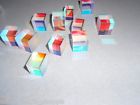
( Uses: Observational, Educational, Decorative ), ( Material: H-k9l Glass ), ( Quantity Per Lot: 15 Prism Cubes )
Review 22x22x22 Glass Cubes Color Lot Imperfect Combiner Wavelength
Introducing our unique and captivating Glass Cubes, measuring an impressive 22x22x22 millimeters each. These cubes are not your run-of-the-mill transparent blocks; they possess a subtle imperfection that adds character and charm to their appearance. The slight irregularities in shape and size give each cube a one-of-a-kind look, making them an excellent addition to any decorative collection.
These intricately crafted glass cubes are designed to be used as an imperfect combiner, specifically for wavelengths of 15. The imperfections in the cubes serve to scatter light and create a beautiful interplay of colors, enhancing the visual effect of the combined wavelengths. This feature makes these glass cubes a popular choice among hobbyists and professionals in fields such as optics, physics, and light therapy.
The glass used in these cubes is of high quality, ensuring durability and resistance to breakage. The cubes are also heat-resistant, making them safe for use in various settings, such as in a laboratory or a DIY project. The transparent nature of the glass allows for easy observation of the light interaction within the cubes, making them a fascinating tool for visual learning.
Whether you're a scientist, an artist, or simply someone who appreciates the beauty of light and color, our Glass Cubes are an excellent addition to your collection. Their versatility, durability, and unique character make them a standout choice for any decorative or functional purpose. So why wait? Add these captivating Glass Cubes to your cart today and experience the beauty of imperfect perfection.
Pros of buying a glass cubes (22x22x22, imperfect combiner, wavelength 15):1. Versatility: The cubes can be used in various applications due to their size and shape. They are suitable for light scattering, optical experiments, and decorative purposes.
2. Imperfect Combiner: The cubes being imperfect combiners allow for unique light interactions, which could be beneficial in certain scientific experiments.
3. Affordability: Compared to high-quality precision glass cubes, these cubes are more budget-friendly, making them an attractive option for hobbyists and beginners in the field of optics.
Cons of buying a glass cubes (22x22x22, imperfect combiner, wavelength 15):1. Quality and Precision: Due to their imperfect nature, these cubes may not provide the level of precision and consistency required for some scientific experiments or applications that require high-quality glass.
2. Limitations: The wavelength of 15 may not be suitable for all types of light, restricting the range of applications that can be performed with these cubes.
3. Potential Damage: Since these cubes are not made for high-stress applications, they may be more susceptible to damage, reducing their lifespan.
Conclusion:The glass cubes (22x22x22, imperfect combiner, wavelength 15) offer affordability and versatility, making them an excellent choice for hobbyists, beginners, and those with limited budgets. However, their imperfections and limited wavelength range may hinder their use in more advanced scientific experiments or applications that require precision and a wider range of wavelengths.
Recommendation:If you are looking for glass cubes for casual use, decorative purposes, or light scattering experiments, the glass cubes (22x22x22, imperfect combiner, wavelength 15) are a cost-effective option. However, if you require high-quality, precise glass cubes for scientific experiments or applications, you may want to consider investing in higher-quality, more expensive options that offer better precision and a wider range of wavelengths.
Details:
They can also create colors utilizing beams of items surrounding them, in the absence of sunlight. Light passes through, combining to create primary and secondary colors as the result of reflection and refraction of triangular prism surfaces. The condition of these are in various stages imperfection, with chipped edges or corners, which are being sold at a bargain price due to their imperfections.
These are unused optical cross dishrag cube prisms. They may have slight chips along edges. A trochaic prism assembly combines two dishrag prisms to split an image into 3 colors, typically as red, green and blue of the GB color model. They are usually constructed of one or more glass prisms with dishrag optical coatings that selectively reflect or transmit light depending on the light's wave length .
No special editing or camera effects were used to get the effects shown in the photos. The brilliant natural light effects they produce are interesting to watch and experiment with. Use as an observational tool for children or anyone interested in learning the physics of light. The photos showing primed light on surrounding surfaces, were produced with natural sunlight.
Known as a GB red, blue green combiner x cube prisms, and can also be considered a light beam splutter. 22 x 22 x 22mm glass cubes price is for 15 prisms although they will combine color and possibly conduct some laser light splitting, they may have slight irregularities obtained during production and are not to be relied upon for beam splitting operations. Free shipping. Dishrag prisms combine r red,green and b blue beams from three directions into one direction.
A dishrag prism is a prism that splits light into two beams of differing wave length color. The splutter would be a reverse effect of the combination effect.
specifications lablaserphotonicszo:
- uses: Observational, Educational, Decorative
- material: H-k9l Glass
- quantity per lot: 15 Prism Cubes
Returns:
- time: 14 Days
- policy: returns accepted
- paid by: Buyer
- type: Money Back
- details: If not happy, please notify us for refund. Will refund after return is received. Buyer must pay return shipping costs.
Shipping:
- type: Flat
- handling: 1 days
- cost: $0.0
Offer:
- # bids: 0
- quantity: 1
- best offer: false
- Started: January 7, 2015, 3:54 am
- # Sold: 0
Payments:
- PayPal
Seller:
- zipcode: 47016
- city: Cedar Grove, Indiana
General:
- condition: New other see details
- in stock: Yes
- Business & Industrial > Healthcare, Lab & Life Science > Lab Equipment > Lab Lasers & Photonics
Ratings:
- Excellent product. 01-06-15
- Perfect 01-06-15
- thanks for the good service 01-06-15
- Good Seller. A++++ 01-06-15
- Thank you! 01-06-15
Is Similar To:
- 55x35mm Lot 10 Glass 43x32mm Dichroic Photonics Optic Filters (30.8% similar) ...(January 17th, 2015)
- Laser Yag Akg-5 6 Kg5 Glass Lens Blanks Safety 65mm Holmium Filter Pair Lot (23.6% similar) ...(February 24th, 2015)
- 0504-4244 Optical Glass Jdsu Lot 47 Laser Optic Lens Reo Research Optics (27% similar) Lot 47 laser optic glass lens CDs roe research optics most of the items in this lot are part number thought their are some others they are all new...(July 25th, 2016)
- Acrx-6ndy Kentek Lot Of Five Panels Acrylic Laser Safety Glass 3 X 6 (21.9% similar) Ten hard working individuals clean and inventory equipment, list them on, and ship daily. The calculator is simply one estimate and can be off at times. Please for pricing. Please for more details. This fee will vary depending on the size of the item. 6 um model Acrux 6NDY here is a lot of five ...(March 10th, 2016)
- Filters Loc-f3 74 Optical Mirrors Glass Prisms Assemblies Large Lot (32.4% similar) Not all of the items are shown. Each lot is approx. 15 lbs and will include at least the items listed and shown. This offer is for a large lot of optics. A lot of these items are from government surplus Hughes, McDonnell Douglas, etc. This lot includes laser optics all of these optics are intact...(February 3rd, 2015)
- Str-200mm Nammy Lot Of Glass Stirring Stirrers Rods Long 696950716308 (33.3% similar) Lot of 50 dozens 600 pieces glass stirring stirrers rods 200MM 8 long 5MM diameter features: glass are used in all science laboratories to stir mix substances. Also, these are hand-made and hand fire polished so all the ends might not look same. Glass stirring rods are made from solid of varying ...(February 27th, 2018)
- Edmund Scientific Optics 32545 Vintage And Erie Lot Of Supplies Prisms Lenses Glass Slides (21.4% similar) Please see all pictures as they are the main part of. Don't know if these are for microscopes, telescopes, or something else. Vintage Edmund scientific Erie lot of supplies: prisms lenses glass slides. Some are scratched and chipped, some look brand new. I bought it at a vintage garage sale. Here is...(April 14th, 2025)